

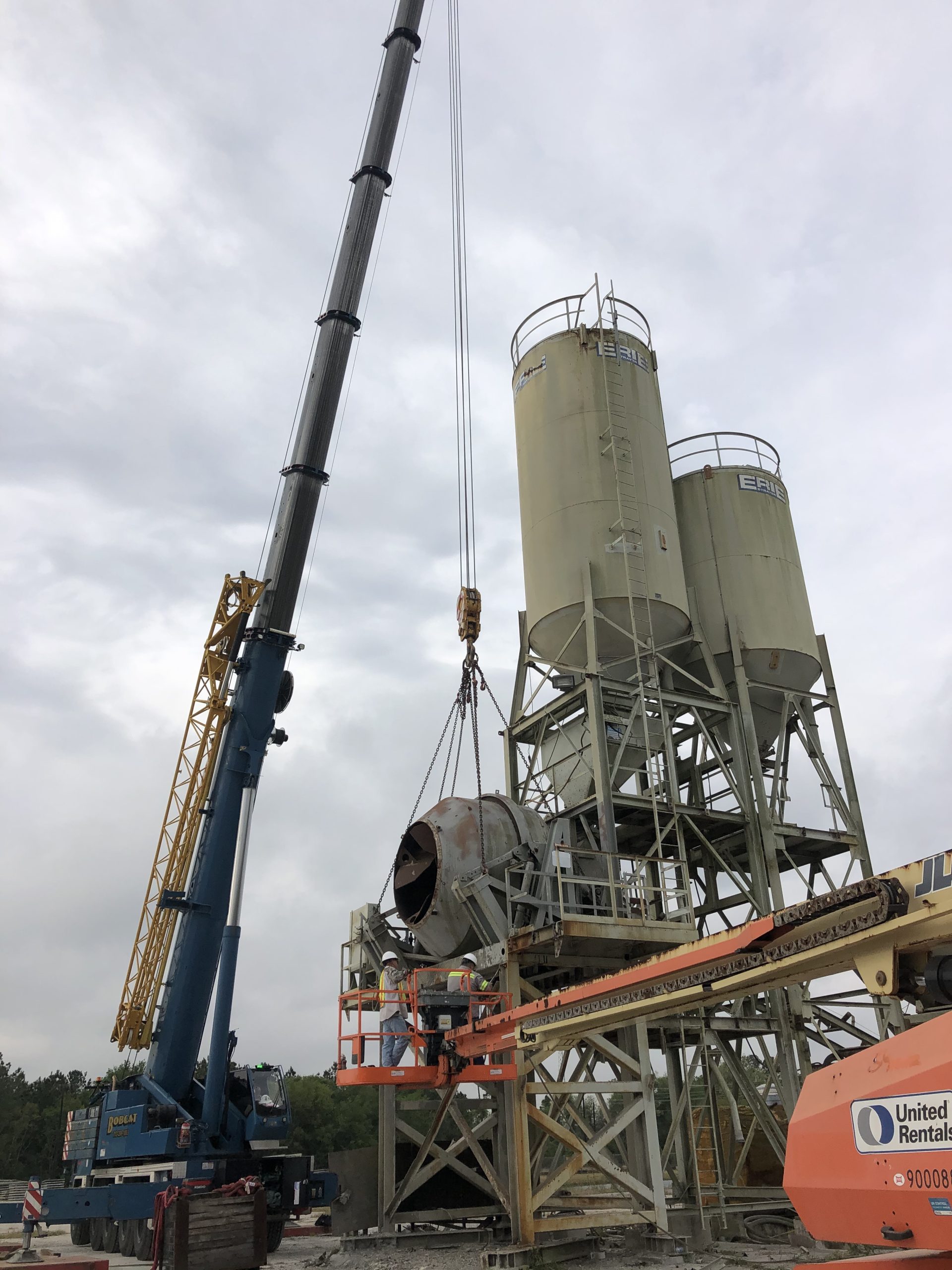
In industrial construction, safely and precisely moving extremely heavy objects is vital. For heavy crane lifting, the crawler crane is unparalleled. These powerful giants offer unmatched stability, immense lifting capacity, and crucial “pick-and-carry” mobility; capabilities that wheel-mounted cranes lack.
At Bobcat Contracting LLC, we know the right machinery ensures project success. We will now explore the engineering, history, and real-world applications of crawler cranes, demonstrating their mastery of heavy lifting.
What is a Crawler Crane?
A crawler crane is a mobile lifting machine mounted on continuous tracks (crawlers). Unlike standard wheeled cranes that rely on outriggers for stability, crawler cranes use their large ground footprint and heavy undercarriage for balance.
The machine has two main parts: an upper structure (housing the engine, cab, and boom) and a “carbody” resting on the tracks. The tracks spread the crane’s weight over a large area, enabling operation on soft or uneven ground where wheeled vehicles would fail.
Crawler cranes typically use a lattice boom, a structural steel-truss design. This design provides superior strength and high lifting capacity while remaining relatively light compared to solid telescopic booms, allowing for greater heights and heavier lifts.
How Have Crawler Cranes Changed Over the Years?
The development of the crawler crane showcases incredible engineering ingenuity. Early versions relied on steam power and were significantly less efficient, frequently requiring many days for assembly and large crews for operation. As the global need for infrastructure expanded, so did the technology behind these machines.
- Power and Precision: The shift from steam power to diesel engines, and now to sophisticated diesel-electric systems, has given operators much finer control. Contemporary crawler cranes incorporate advanced hydraulic systems, which allow for “millimeter-perfect” placement when seating a critical bridge beam or a large wind turbine nacelle.
- Modular Assembly: For many years, moving a crawler crane was an enormous logistical puzzle. Now, manufacturers engineer these cranes for modularity. They can be disassembled into sections that fit onto standard road trailers and reassembled on the job site with “self-erection” technologies, dramatically lowering the costs and time associated with mobilization.
- Safety and Telematics: New-generation units come equipped with Load Moment Indicators (LMI) and integrated computers that constantly monitor factors such as wind speed, ground pressure, and load weight. This equipment is vital for preventing accidents, ensuring that heavy crane lifting activities always remain within the established safety limits.
Crawler Crane Load Capacity
The most defining feature of the crawler crane is its sheer power. Lifting capacity varies widely, but these machines are generally built for the most challenging tasks. Smaller crawler cranes may start with a 50-ton capacity, while the largest “super-lift” versions can manage lifts exceeding 3,000 tons.
A number of factors determine a crawler crane’s maximum capacity:
- The Counterweight: Large, detachable counterweights are positioned at the crane’s rear to balance the heavy load being lifted.
- Boom Length and Angle: Just like any crane, the closer the load is to the center of rotation (a shorter radius), the greater the weight the crane can safely lift.
- Track Width: Many modern crawlers feature hydraulically extendable tracks. Widening the tracks enhances the crane’s foundational stability, which permits higher capacities without needing extra counterweight.
Perhaps the greatest benefit regarding capacity is the crane’s “pick-and-carry” ability. Since the crane remains stable on its tracks, it can lift a heavy load and drive it to a new location on the site. This feature eliminates the need for multiple separate lifts and avoids the requirement for secondary transport vehicles.
What Applications Are Crawler Cranes Used For?
Given their robustness and adaptability, crawler cranes are essential across nearly every heavy industry sector. Their proficiency in operating on undeveloped ground makes them the preferred choice for:
- Energy and Power Plants: Whether lifting massive reactors at a refinery or installing huge boilers in a power station, crawler cranes provide the necessary reach and capacity for the energy industry’s demands.
- Wind Energy: The wind power sector heavily relies on these cranes. Putting up towering wind turbine masts and lifting the large blades and nacelles requires a crane that can navigate the soft, often sloped ground of a wind farm while maintaining stability for high-altitude lifts.
- Marine and Port Construction: Crawler cranes are frequently driven onto specialized barges for construction projects near the shore, such as building piers, docks, or bridges. Their inherent stability makes them perfectly suited for the dynamic environment of water-based lifting.
- Industrial Maintenance: In large industrial facilities like petrochemical plants, crawler cranes are used during facility “turnarounds” to safely remove and replace oversized equipment like heat exchangers and pressure vessels.
Best Types of Projects for Crawler Cranes
While the crawler crane is a formidable machine, it excels in specific project types where its unique strengths can be fully leveraged.
Long-Duration Projects
Because setting up a crawler crane requires transporting it on multiple trucks and assembling it on-site, it is most cost-effective for projects that will span several weeks or even months. Once assembled, their on-site efficiency and mobility quickly justify the initial setup investment.
Large-Scale Infrastructure
Bridge construction is a perfect example. A crawler crane can be positioned on the riverbank or on a barge, lift an enormous concrete girder, and “crawl” it into the precise final placement. The lattice boom can be configured for immense lengths, enabling the crane to work across spans that other types of cranes could not reach.
Soft or Unstable Terrain
If a job site is muddy or composed of loose soil, a wheeled crane would either get stuck or require the placement of expensive timber mats across the entire site. Crawler cranes distribute their weight so effectively, often putting less pressure on the ground than an average human footprint, that they can keep working in conditions that would stop other operations entirely.
High-Volume Lifting
On job sites that require hundreds of individual lifts in various locations, such as a major warehouse development or a large stadium construction, the ability to move while under load is a huge time-saver. Instead of raising outriggers, relocating, and resetting for every single lift, the crawler simply drives itself to the next required pick point.
Contact Bobcat Contracting LLC for Heavy Crane Lifting Services
At Bobcat Contracting LLC, we pride ourselves on providing top-tier crane services backed by a culture of safety and technical expertise. We know that heavy crane lifting is a high-stakes environment where precision is non-negotiable.
Contact Bobcat Contracting LLC today to discuss your project requirements and let us provide the lifting solutions you need to move your business forward.
